Seed Round • HydroBot™ Pilot Plant Construction

On-Demand Clean Energy:
Zero High Pressure & +95% Gross Margin

We democratize distributed power generation and zero-emission mobility by combining PEM fuel cells with HydroBots™: sealed, autonomous units that produce hydrogen on demand using 100% recyclable solid pellets regenerated with solar or wind power.

>95%
Refill Gross Margin
0 Bar
H₂ Gas in Transit
100%
Autonomous Plug & Play
< Grid
Disruptive LCOE
Watch Video Pitch (1:46) Explore the Technology Profitability Simulator
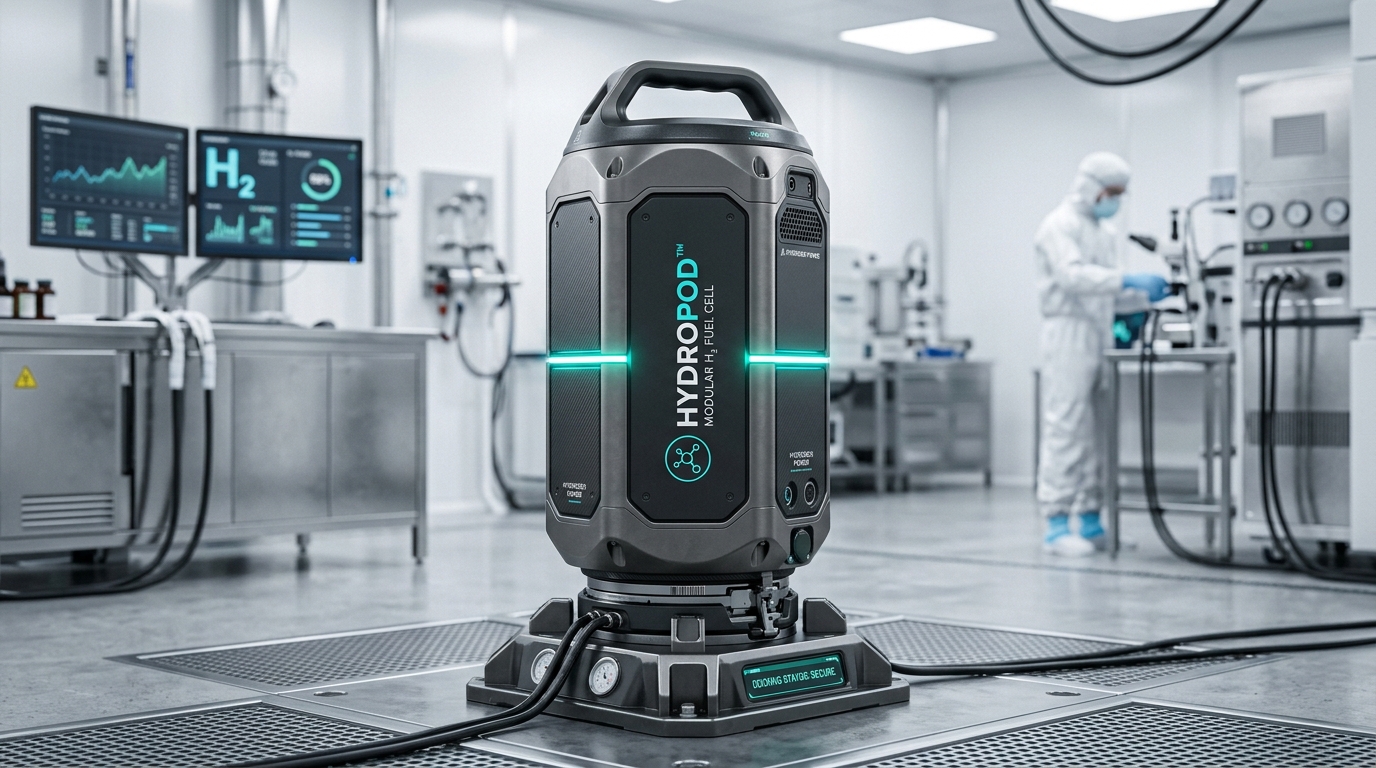
3D Render of HydroBot™
HydroBot™ Power Module
Sealed autonomous capsule • On-demand H₂ generation
Hot-Swappable
Electrochemical Principle

1. What is a PEM Fuel Cell (PEM FC)?

A Proton Exchange Membrane (PEM) fuel cell is a high-efficiency electrochemical device that directly converts the chemical energy of Hydrogen (H₂) and Oxygen from the air (O₂) into continuous DC electricity, releasing only pure water vapor (H₂O) and useful waste heat.

PEM Fuel Cell Architecture 0% CO₂ EMISSIONS

ANODE (-) H₂ Oxidation H₂ → 2H⁺ + 2e⁻ H₂ Bot MEMBRANE PEM POLYMER Exclusive H⁺ passage CATHODE (+) O₂ Reduction 4H⁺+4e⁻+O₂→2H₂O Air (O₂) Pure H₂O Vapor ⚡ DC Current (e⁻)
Continuous electrochemical performance with no wearing moving parts or combustion.
01

Safe Hydrogen Supply

The HydroBot delivers regulated, low-pressure hydrogen (< 3 bar) directly to the PEM fuel cell anode without requiring preheating or external compressors.

02

Catalytic Dissociation

At the platinum-nanocatalyst anode, each H₂ molecule splits into 2 protons (H⁺) and 2 electrons (e⁻).

03

Selective Membrane & Electric Circuit

The polymer membrane only allows protons to pass through. Electrons travel along the external circuit, generating instant continuous electricity for the consumer load or electric motor.

04

Clean Recombination

At the cathode, protons and electrons reunite with ambient oxygen, producing useful heat and 100% pure distilled water. Zero CO₂, NOx, or particulate emissions.

Comparison Parameter PEM Cell + HydroBot™ Lithium Batteries (Li-ion) Traditional Diesel Generator
Direct Emissions 0% (Water Vapor Only) 0% local (High mining & recycling footprint) High (CO₂, NOx, Sulfur Dioxide, Soot)
Refueling Time 60 Seconds (HydroBot Swap) 4 to 8 hours of slow grid charging 5 minutes (volatile fossil fuel)
Operating Lifespan >40,000 Hours without degradation Severe degradation after 1,000–1,500 cycles High mechanical wear & continuous maintenance
Gravimetric Energy Density Up to 3x higher than Lithium Limited by cell dead weight High, but with low thermal efficiency (<32%)
Transport Safety Solid reactant + Water (Zero High Pressure) Thermal runaway & fire risk Highly flammable & toxic liquid
Massive Target Markets

2. PEM Fuel Cell Applications

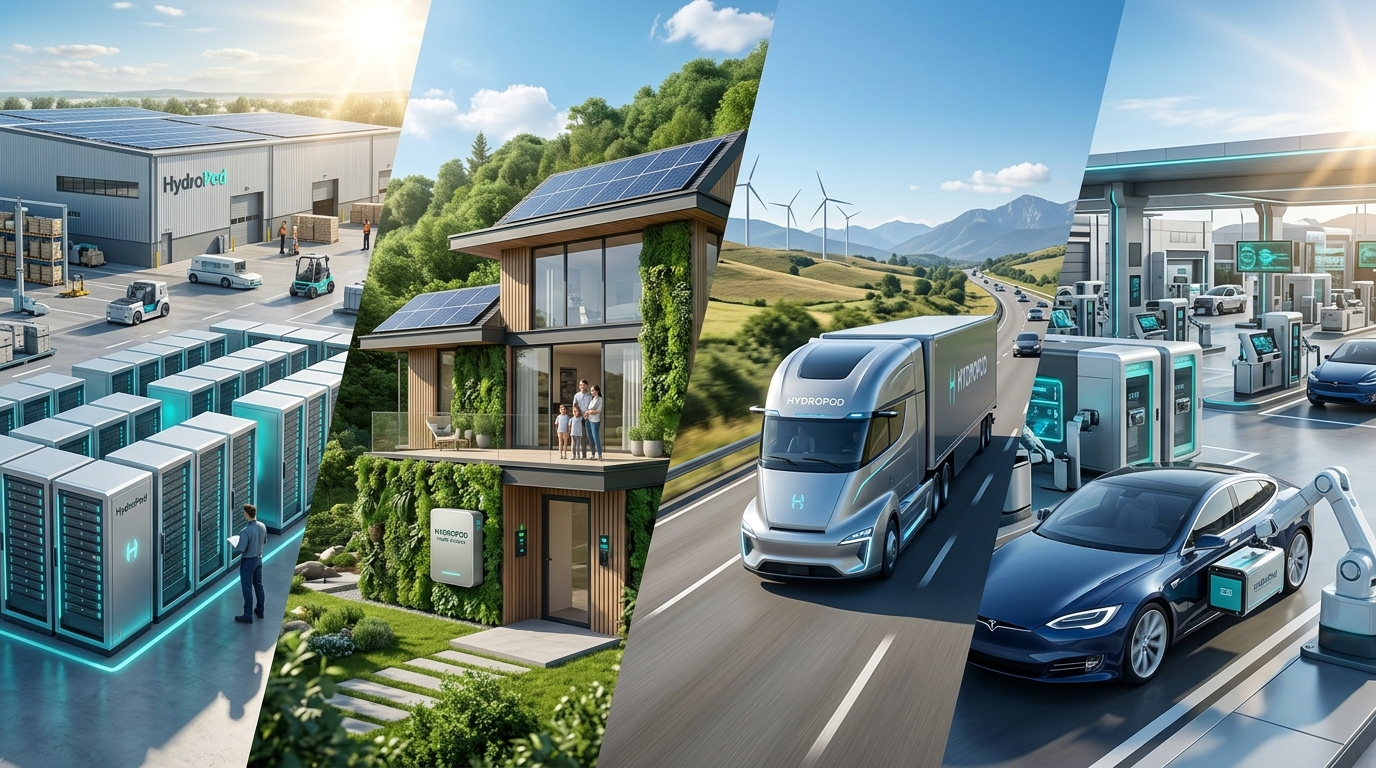
The versatility of PEM technology combined with autonomous HydroBot supply unlocks four massive markets with high willingness to pay and an urgent need for decarbonization.

PEM Applications Showcase: Industrial, Residential, Trucks, and Passenger Cars

Industrial Power Generation

Immediate replacement for diesel generators at mining sites, data centers, telecom towers, and industrial microgrids. Delivers 24/7 continuous backup with zero noise or carbon emission penalties.

Typical Power: 50 kW - 2 MW
Availability: 99.99% Uptime
Billing Model: USD / kWh

Residential & Home Energy

Complete energy independence from the public grid. Domestic micro-cogeneration: clean electricity plus usable heat for space heating and domestic hot water, eliminating blackouts in rural or suburban homes.

Typical Power: 3 kW - 15 kW
Cogeneration: 85% Total Efficiency
Billing Model: USD / kWh

Passenger Vehicles

Electric mobility without the dead weight or charging wait times of lithium batteries. Over 700 km of range and 3-minute refueling at modular HydroBot swap stations.

Range: > 700 km
Swap Time: < 3 minutes
Billing Model: USD / kg H₂

Heavy-Duty Transport & Fleets

The ultimate energy vector for long-haul trucks, buses, and heavy machinery. Does not sacrifice payload capacity (tonnage) the way massive 8-ton lithium batteries do.

Payload Capacity: 100% Payload
Operating Range: 1,000+ km
Billing Model: USD / kg H₂
Energy Distribution Innovation

3. The HydroBot™ Concept: Sealed Autonomous Unit

The HydroBot™ solves hydrogen's Achilles' heel: compression, cryogenic, and pipeline transport infrastructure. It is a compact, hermetically sealed, 100% plug & play module.

Zero External Connections

Requires no electrical grid connection to operate, nor running water supply or external pumps. It is a 100% self-contained system passively pressurized at low pressure.

"Hot-Swap" Replacement

When the reactant is depleted, the HydroBot decouples in under 60 seconds via its hermetic Smart-Lock connector and is replaced with a fresh unit without interrupting the customer's power supply.

HydroBot-as-a-Service (HaaS)

Our company takes full lifecycle responsibility: 24/7 IoT state-of-charge telemetry, predictive replenishment logistics, and preventive maintenance guaranteed by SLA contract.

Transparent Monetization Model

We Charge Only for the Energy or Molecule Consumed

The end customer makes no astronomical upfront outlays on electrolysis plants or cryogenic storage. They only pay for the service:

Stationary Power Generation

Industrial & Residential Customers

We install HydroBots at fixed sites connected to stationary PEM fuel cells.

$0.12 - $0.16 USD / kWh generated
  • Audited monthly billing via certified IoT telemetry
  • Up to 35% cheaper than peak-hour grid electricity and diesel
  • Zero CAPEX or depreciation risk for the customer
Mobility & Transport

Vehicles, Fleets & Heavy-Duty Trucks

Rapid swapping at nodal stations or direct dispensing into vehicle tanks.

$6.00 - $7.50 USD / kg H₂ dispensed
  • Lower cost per kilometer driven than Euro VI diesel trucks
  • 3-minute HydroBot swap: 100% driver productivity with zero charging downtime
  • Certified zero-emission green H₂ traceability
The Profitability Secret

4. The Chemical Moat & 100% Circular Economy

HydroBots DO NOT transport high-pressure hydrogen gas or cryogenic liquid. Inside, they carry water and solid pellets containing a reactive compound. Once the pellets are spent, the byproduct is 100% recyclable into new pellets using solar or wind electricity.

1. Pellets + Water

The HydroBot is loaded at the plant with stabilized water and stable solid pellets. No free gas; ultra-safe transport at ambient pressure.

2. On-Demand H₂

Once coupled, a controlled reaction is triggered. H₂ is generated exclusively matching the PEM fuel cell's consumption at < 3 bar pressure.

3. Contained Byproduct

As pellets are consumed, 100% of the remaining mass (stable byproduct) stays safely sealed inside the HydroBot. Zero leaks or emissions.

4. Reverse Logistics

We retrieve the depleted HydroBot and insert a fresh one. The spent unit returns to the Pilot Plant for closed-loop reprocessing.

5. Solar Regeneration

Using low-cost solar/wind electricity, the byproduct is 100% regenerated into new pellets ready to return to the market.

Unbeatable Unit Economics

Why Does the Gross Margin Exceed 95%?

In the traditional energy model, every kWh requires burning virgin fossil fuel or buying chemical reactants that are irreversibly destroyed.

In our system, the reactive chemical carrier is a permanent circulating asset: we do not purchase raw inputs over and over again. The only direct operating cost of regeneration is the Pilot Plant's electrical energy, supplied by solar and wind farms at an ultra-low marginal cost (~$0.02 - $0.03 / renewable kWh). After accounting for minimal physical losses (<5%), the refill gross margin exceeds 95%, enabling us to deliver distributed energy cheaper than any alternative on the market.

>95%
Refill Gross Margin
Perpetual cycle of reactive pellets regenerated with renewable electrons
Live Financial Modeling

5. Unit Economics & Investor Return Simulator

Explore the impact on billing, operating margin, and customer savings under the HydroBot-as-a-Service (HaaS) model.

PEM Fuel Cell Capacity (Continuous Power) 50 kW
Min: 5 kW Max: 500 kW
Average Daily Operating Hours 16 h/day
Min: 4 h Max: 24 h (Continuous)
Model Assumptions: Competitive HydroBot rate vs. diesel/grid benchmark; solar regeneration electricity cost at $0.028/kWh; estimated cycle losses at 4.7%.
Total Generation 24,000 kWh/mo
Monthly Customer Billing (HaaS) $3,360 USD/mo
Customer Savings vs. Diesel/Grid $1,920 USD/mo (-36%)
Marginal Pellet Regeneration Cost $156 USD/mo
Operating Gross Margin 95.4%
CO₂ Emissions Avoided 10.8 Tons
Investment Opportunity

6. Pilot Plant Project: Commercial Deployment in Mojave

An execution plan focused on immediate commercial traction: plant equipment procurement and installation in 6 months, followed by operational pilot deployment at a strategic truck stop in the Mojave Desert.

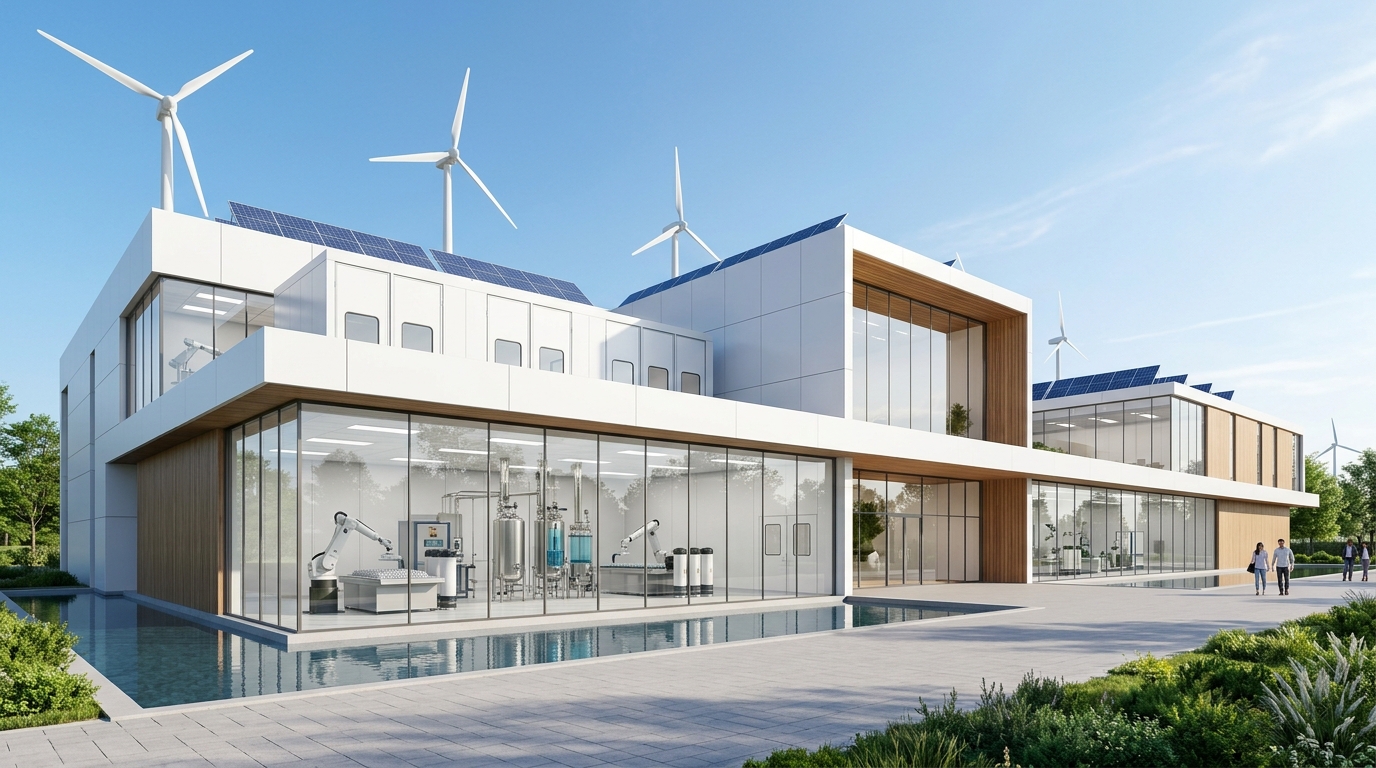
Architectural Render of the Green Hydrogen Pilot Plant

Commercial Pilot Execution Plan (9 to 12 Months)

Phase 1 • Months 1 to 6
Plant Equipment Procurement & Installation
With the production line already fully engineered and ready for execution, this phase focuses on procuring, assembling, and commissioning the industrial equipment for pellet synthesis and HydroBot assembly.
Phase 2 • Months 7 to 12 (3 to 6 Months)
Deployment of the First 6 HydroBots in the Mojave Desert
Operational launch at a strategic Truck Stop in the Mojave Desert. Supplying with 3 HydroBots in simultaneous service and 3 HydroBots in recharge and swap rotation, selling an expected average of 300 kg of H₂ / day to commercial transport fleets.
6 Months
Phase 1: Procurement & Installation (Line Already Engineered)
6 HydroBots
3 in Continuous Service + 3 in Swap Rotation
300 kg/day
Projected Average at Mojave Truck Stop

Be Part of the First Profitable Hydrogen Ecosystem

Access the confidential Data Room, detailed financial model, and schedule a working session with the engineering and Powerball Technologies team.

Watch Video Pitch (1:46)